I am about one paragraph into my first paper of the semester and what better time to write a blog post than when you’re looking for a way to procrastinate, n’est-ce pas? It is Sunday night which means that my journey to Senegal began exactly one week ago. Every day this week (and every hour of each of those days) I would have written a completely different post had I had the time to sit down or the necessary internet. It is true that life in a new culture is a rollercoaster—emotions change at least every hour and what you thought you just figured out is challenged even more often. But one thing remains constant, which is that I am kind of, sort of head over heels for Senegal. As many of you know, I was apprehensive about coming here, wondering why I chose to go to Senegal when I had never once showed any interest in West Africa. But now that I am here, there is something very internal to the Senegalese culture that makes me feel at home. I think a lot it has to do with how being here seems to contradict the fear that people have about moving to the “Third World.” We talk about it as if it is a sacrifice, when in fact the reality of it has taught me that it is a give and take, both in terms of material processions and cultural ways of life. Yes, I don’t have internet at home (gasp), the electricity goes out multiple times a day, my shower faucet is a trickle of cold water, the roads would make a worthy ride at any amusement park and I’m pretty sure there is a colony of beetles living in every corner of my room, but something about the context of being here puts all of these things in perspective: they are small and quite simply, c’est la vie.
I have certainly gained much more out of my week here than the relative comfort I gave up. I will start from the beginning: After arriving in Dakar on Monday morning (at 6 am!), we spent the day (my birthday!) kicking off orientation. The students that had just arrived met up with those that had been here for the month long pre-session. We ate Senegalese food for the first time, danced, talked and got a quick introduction to what to expect in the coming week. The day felt like a few days in one, what with jetlag and sensory overload.
The next day, we moved in with our host families. I was kind of shocked that it was happening so fast, but now I am very thankful to have jumped right in. My host family is composed of a 75-year-old woman who doesn’t look a day over forty (I hope I can age like the Senegalese!). She is a very calm woman, asks you “ca va?” every other sentence and always matches her sunglasses to her scarves, which also match her dresses perfectly. We don’t have the easiest time understanding each other, but we are slowly getting to know one another. I also have a “Tata” (aunt) who works a lot, but whom I see most evenings. Her grandchild is staying with us for a few weeks and he is seriously the most adorable kid I’ve ever seen. He’s four ¼ and considering his age and the fact that neither of us speaks the other’s language, we talk in funny faces and lots of stuck out tongues. My host mom’s brother also lives with us, but he is very sick and stays in his room all the time, so I haven’t really talked with him yet. I would really like to make more of an effort to get to know him, but I don’t know how to go about it. Also, in Senegalese culture, most families have a girl living with them whose job it is to take care of the house and cook, but who also becomes integrated into the family. The girl that lives with my family has been working here for 18 years (she came when she was 11). It’s insane, but taking girls out of villages to support their families at a young age seems to be one of the solutions to rural poverty people have found here.
My family lives in the Liberte 2 neighborhood, which is about a 45 minute walk from school and about the median distance from school as far as where the other students live. Our house is very nice and I have my own room and bathroom (which is quite the luxury I am learning). So far, my daily routine includes being woken up by my host mother who yells my Senegalese name, Maymuna, throughout the house until I yell back loudly enough, eating a breakfast of baguette and tea, then walking to school with another exchange student who lives less than a block from me. Together, we navigate the busy streets, cracked sidewalks and piles of sand, dodge cars (honestly, I will probably get hit before I leave this country), pass the dozens of children begging on the streets and usually run into a few other Americans doing the same thing on their way to school. Last week we had orientation, which was conducted in a very Senegalese way—slowly, very confusing and with a lot of time to relax in between sessions. We took a trip out of the city to Goree Island, which was the largest port for the slave trade. It was a very emotional experience to see the reality of what we had only read about in history textbooks. On this trip, we also visited the women’s history museum and the beach! Our other excursion was a tour of the city, stopping at the most significant sites, like the Presidential Palace, the largest bronze sculpture in the world that is currently being constructed, the most Western point of Africa, the Mosquee de la Divinite and the downtown market, among other sites. Other than these two trips, we spent a lot of time at WARC, which is our host institution.
In the evening I will walk back home in time to break the fast with my family. They are observing Ramadan and the tradition is to drink a sweet beverage and eat a little bread at exactly sunset. After this, they pray and we eat dinner. Dinner is always delicious and always eaten with our hands. There is a real technique to it that involves balling the rice in your palm and scooting into your mouth. I have quite mastered it yet, so they make me eat with a huge napkin over my lap. One day though, I will be good enough at it to teach you all, inshallah!
Well, there are endless things to write, but also a long time to do so. I’m starting to feel guilty for the procrastination, so until next time…
Tuesday, September 8, 2009

Wednesday, August 26, 2009
A Sneaky Departure
It's a little after three in the morning and I've reached that pre-departure anxiousness that leaves me unable to sleep or stop wondering what exactly is ahead or if I'm forgetting anything behind. I'm streaming music on-line, listening to the Southern bands whose shows I used to regularly attend, while the drone of my parents' snoring rolls under the melodies. Like the calls to prayer, the honking of taxis and the bicycle tires treading gravel roads in Tunisia, it did not take long for me to grow accustomed to the sounds of Louisville again--the ring of my cell phone when a friend calls, my father's constant listening to CNN and the thumping bass of cars driving down my block, their "pimped out" rims bouncing in the stale Louisville air. Unlike my Tunisian summer, however, Louisville carries with it a certain feeling of nostalgia--of being here, but living in the past every time I go over to a best friend's house or hang out at my favorite coffee shop. And it carries with it a certain feeling of leaving--constantly calling travel agents to organize the complex criss-cross of flights I have taken and will take this year, filling out clearances for a job I will have in 4 years and rehearsing verb conjugations for a language I will speak daily in less than a week. Maybe that, more than anything, is what makes Louisville a home, in the Yohannes family sense of the word--the place you live, come back to and leave again, but a place in which your whole self is never truly settled.
On Sunday I leave for Senegal. I am already dreading the rude alarm clock awakening for my 6 a.m. flight, but I am both excited and curious for my semester in Senegal. To give you all a glimpse of my upcoming year, here is a rough itinerary (to be detailed after the fact):
August 30 to Mid-October: I will be in Dakar (Senegal's capitol), taking classes in French about development, Senegal and the Wolof language. I will live with a host family and study with the thirty-some other MSID (Minnesota Studies in International Development) students.
Mid-October to early December: I move to a rural location in Senegal, where I will spend six weeks completing an internship with a local non-profit. I will live with another host family and will be apart from the other students.
Early December to December 11: Our final week of the program is spent back in Dakar, where we write a paper and wrap up the program.
December 13 to January 2: I will have a real Parisian adventure! Melinda and I are spending about a week in Paris, seeing how our African French holds up. Then, I will head to Germany (I'm so happy to be going back!), where I will spend Christmas with some family friends.
January 2 to June 6: My semester as part of the Macalester Program in Globalization from a Comparative Perspective begins with a month long seminar led by Macalester faculty and staff, during which we will visit the Hague, Brussels and Amsterdam (!!!). Then, I will take classes at the University of Maastricht, live in international student dorms with the other participants (there are six of us together) and work on a big research paper I will have started researching in Senegal.
There is an Arabic word that should follow all of this: Inshallah, or hopefully, God-willing. Until my ultimate road trip of sorts begins, I have a lot to fit in. From the State Fair and visits to my favorite neighborhoods to sharing food with good friends and family to saying good-byes to people and places I only just said hello to, I will try to make the most of my last few days in this city. You probably won't hear from me until I have touched down in Senegal. Like in Tunisia, I will try to post as regularly as I can, but I have no idea what that will mean for this trip.
Saturday, August 1, 2009
Many Finals
Today I am writing on my last day in Tunisia—a country that welcomed me two months ago and that has since housed both my frustration and excitement about learning Arabic, countless experiences in every one of its four corners and that has inspired and shaped many friendships across national and state borders. When I moved back to the States after living in Germany, my host family taught me a very useful expression—one eye crying, the other smiling. I think this is a fitting proverb for my departure from Tunisia—I hadn’t admitted how much I liked this country, its people or how very much I appreciated all the individuals in the program until the past few days, when everyone’s voice began to carry this nostalgic tone that induces me to tear up (just a little). The past week has indeed been filled with a lot of in-program reflection, juxtaposed with the nerves of taking a huge final (worth 100 points, compared to our usual 20 point exams) and an oral proficiency interview administered by representatives of the Department of State. I am happy to report that I passed all of the above and pulled out an A in the program (I’ll have proof to put on the fridge). But with the excitement of the academics coming to a much needed close, also comes the reality of good-byes. Yesterday, we had our final banquet and graduation ceremony. Every student brought two members of their host family to a beautiful out-doors event held at a classy hotel in Sidi Bou Said. We ate a buffet (a very fitting mélange of American and Tunisian foods and a reminder of how excited I am to eat some of my favourite American foods again), spent at least an hour taking photos of every combination of students and teachers imaginable and then walked across the “stage” to get our diplomas—cased in a beautiful burgundy folder with a door to Sidi Bou in gold on the cover. It was so much like a graduation—everyone milling around after the last name had been called, not really wanting to say good-bye to all the teachers or close the official door to our summer in Tunisia.

I’m very excited for what comes next though, for me and for everyone. Students on this program are going to be scattered across the globe—one friend is beginning a master’s program in Paris, another is doing missionary work in Niger, one is starting a new job on the Mexico border, one is moving to St. John’s, others are studying abroad or just graduated and are waiting to answer the question of what comes next. As for me, I am going to Senegal on August 30—leaving one day before my birthday and touching down on my actual birthday. I hope Senegal will be as wonderful a host as Tunisia has been and Tunisia has definitely given me advice to take to Senegal with me: from what not wear in a scorching climate (unfortunately, most of what I brought with me/own) to how rewarding it can be to reach out to people and take chances with your language. I will be going into Senegal with more confidence than I had originally anticipated, but stand ready and willing to have all of my expectations turned on their face.
And with this, I officially write the last period on my chapter about Tunisia—although the chapter will never really be closed.


Sunday, July 26, 2009
Happenings and Reflections
I'm back in my host family's living room listening to the hum of France24 on the t.v., watching my host mother pray on a tapestry from the corner of my eye and full-heartedly emphathizing with my host sisters that they have to live in this Mediterranean heat 12 months out of the year, whereas me...well, I'll be leaving in 1 week, a fact that blows my mind. Today I returned from my final program excursion (to the Cap Bon), which marked the first official "last" of something from the program. From now on, it is time for going down the hill, picking up pieces and remembering what it is like to leave a place I might never return to and people I might never see again. This weekend, some of us students had talked about things that we've started taking for granted here and what it will be like to be back in the US away from them--will we be startled by the silent absence of the call to prayer? feel lonely away from the friendliness and forwardness of Tunisian culture? And a life away from the beach--I don't even know if I'll be able to cope. The following are some things I've grown accustomed to in Tunisia, but might have neglected to mention:
--Five times a day, I hear the call to prayer—a lulling Muslim prayer sung through a raspy intercom. It echoes throughout Tunisian towns and from my house (where I can see ten mosques from the roof), I hear the prayer loudly and with words easily defined. From school in Sidi Bou Said, however, the prayer is distant and easily mistaken for slight hum of a radio.
--Greetings in Tunisian dialect are very simple: just like the French say Ca vas?, which is both a question and a reply, the Tunisians say La bess? However, these two little words can often lead to a cycle of repeating the phrase over and over again, because Tunisian dialect loves to use repetition, leaving you unaware of whether your question has been answered or if you’ve been asked. This confusion will lead me to keep repeating the phrase and by the end of an interaction, La bess has probably been said 10 times by each of us.
***

And now, it's into the final week. For the rest of our studies, we will not be learning any new material, but rather reviewing. We've completed 15 chapters of my thickest textbook to date in a program that has covered what some colleges consider two year of Arabic instruction. Needless to say, I'm exhausted, but will still try to savour this last week to the best of my ability.
--Five times a day, I hear the call to prayer—a lulling Muslim prayer sung through a raspy intercom. It echoes throughout Tunisian towns and from my house (where I can see ten mosques from the roof), I hear the prayer loudly and with words easily defined. From school in Sidi Bou Said, however, the prayer is distant and easily mistaken for slight hum of a radio.
--Greetings in Tunisian dialect are very simple: just like the French say Ca vas?, which is both a question and a reply, the Tunisians say La bess? However, these two little words can often lead to a cycle of repeating the phrase over and over again, because Tunisian dialect loves to use repetition, leaving you unaware of whether your question has been answered or if you’ve been asked. This confusion will lead me to keep repeating the phrase and by the end of an interaction, La bess has probably been said 10 times by each of us.
--Cats are everywhere in this country—roaming streets, sleeping under cars, eating out of trash cans…No one seems to own animals here, but the number of homeless cats (and some dogs) is pretty out of this world.
--Tunisians are addicted to sugar. Fruit is always eaten on the very last day it could be edible to ensure it is at its sweetest; tea and coffee is served with equal amounts water and sugar (only a slight exaggeration) and every time I try to buy plain yougurt at any grocery store, the person checking me out warns me that I am about to buy something without sugar as if I should put it back.
--The two most common things you can buy on the street are breadstick crackers (unfortunately pretty tasteless and undelicious for how prevalent they are) and mini flower bouquets. Men and boys walk up and down the sidewalk dressed in red vests selling these little handpicked (from someone’s garden) flower arrangements that other men will buy and hold in their palms all day, bringing the flowers up to their noses every once in a while, or will put them behind their eyes while sitting at cafes.
***

As for the weekend trip--it was everything I needed and put the icing on the cake of my spoiling. We visited the Northwest, the region known for supplying the country with oranges and grapes. Tunisia has a tradtion of every city and town displaying a large statue in it's center to represent what the city is known for. We've seen a coral statue, a saxaphone, a stork...and now we can add a tomatoe, orange and grapevine to our list. On our way to our final destination of Hammemet, a center of tourism in Tunisia, we made a few stops. We visited another city of ancient ruins and an adorable art gallery and restaurant overlooking the Sea for our second stop. From the roof of the restaurant, we had an incredible view of white houses and blue shutters in every direction save for the dock. It was one of those picturesque places you never want ot leave.

We got into Hammamet in the early evening and had free time until today, when we left at 2. We stayed at a 5 star hotel with rooms with ocean front views and I did nothing but swim, shop and eat way too much food at the buffets. It was the kind of vacation I would've never allowed myself to do on my own, but I'm really thankful for it after one of the most stressful weeks in the program. Hammamet completed my picture of Tunisia and showed me how much I've gotten to now this country for what it really is, which is not a resort in an area with more tourists than Tunisians.
And now, it's into the final week. For the rest of our studies, we will not be learning any new material, but rather reviewing. We've completed 15 chapters of my thickest textbook to date in a program that has covered what some colleges consider two year of Arabic instruction. Needless to say, I'm exhausted, but will still try to savour this last week to the best of my ability.
Wednesday, July 15, 2009
No news is good news, right?
Sorry about the lack of updates--I've tried multiple times and each attempt ends with my falling asleep and adding random sentences while I nod off, none of which make sense when I wake up. So, take 5...
This has been an eventful week filled with a lot of cultural excursions in the Tunis area. As for the wedding I mentioned in my last post, I ended up attending two of the wedding ceremonies. In Tunisia, weddings are multiple day long parties that include a separate party for both the bride and groom, a party for the signing of the contract, multiple dinners with the entire family and, finally, the actual wedding party. On Sunday night (as in 2 Sundays ago now), I attended the party for the groom a couple of blocks from my house. Practically the entire bunch of us Americans were there as everyone in al Marsa knows each other and they all go to about twenty weddings a week in the summer. The party was mostly just sitting and listening to music blare, but the really neat part was when the groom debuted. He came out appearing frail and unable to walk with his entire family behind him. This was to symbolize the support of the family. The procession walked this way from his home to the party with red and green flags (the colors of weddings) waving and everyone chanting and drumming. Once at the party, the groom got a dot of henna applied to his pinky and everyone gathered around him to give him money and good wishes.
On Tuesday, I attended the actual wedding party. It was pretty similar in that everyone sat and listened to music, except it was held in an ornate wedding hall rather than outside. The bride was also present (of course) and she wore the most elaborately beautiful dress. The two of them sat in thrones in the front of the audience while a cameraman filmed close-ups of them relentlessly that were channeled to a big screen TV in the front of the room. Weddings here follow a complicated traditional process of dancing at certain times, sitting at others, watching the bride dance then the groom, dancing with the couple...I didn't quite get the hang of it, so I just danced, sat and stood awkwardly wondering if I was doing the right thing at the right time, but it was a fun experience.
Thursday, all of the women in the group went to a hammam, which is a Turkish bath. Two of the girls in the program are getting married shortly after we return to the U.S., so this was like a bridal shower for them, because it is customary for women to gather in hammams to begin the wedding ceremony. We entered the hammam banging barbuka drums and singing and, once inside, we lit candles and danced before going into the actual baths. The baths were much different than what I had expected—they were slabs of tile that you could sit on in three different rooms of varying heat. In the central room, you could pay a woman to scrub you down or to get a full body mask or massage. It sounds weird, I know, but in the context of the hammam, it was all very normal. We spent hours in there and then left the baths to have another celebration in the foyer. The two brides-to-be got henna applied and wore some of the traditional wedding accessories, like ornate metal shoes and special gloves while the henna dried.
On Friday we had our weekly test and afterwards I was in need of some major non-Arabic time. So, I had a night out with the girls--very classic summer, but with a Tunisian twist. We “did Bousalsla,” which is the street that most of us live on or off of and it gets kind of hopping on a Friday night. We went to a cafe for pizza and the pizza cost 1 dinar (about 75 cents) for each person to get their own small pizza! Then we went back to one of the girls in the program's house with the intention of baking a cake, except her host family wasn't there and we couldn't figure out how to light the oven. So instead of baking a cake, we fried a cake! Considering that Tunisian cooking has everything slathered in oil, it was very traditional of us--cake pancakes are actually good!
After I got home late that night, I had the most epic conversation with my hostfather about the Congo, his home country. He told me all about the history, the culture, the languages, etc of the country. What was so funny to me was that our entire conversation seemed like a dialogue taken from my French 204 book--using vocab about immigration and assimilation, languages, and foreign aid/globalization and development. At the time we were learning that in school, it seemed useless to know the word for "indigenous language" before I felt truly comfortable holding a basic conversation. What I've learned, however, is that the in-between vocab and comfort starts to come naturally and I'm actually really thankful that we spent so much time learning what felt like impractical vocab. Now, I just hope that my Arabic vocabulary will come in just as handy (although I have a little less hope for our vocab words like humidity and overcrowdedness).

This finally brings me to a more recent time. The theme of this week at school is music. On Monday, a very famous group of classical Tunisian musicians performed for us at our school. The music was absolutely incredible and they played a lot of covers and I was surprised to recognize so many of the songs. Then, yesterday, I attended the International Carthage Music Festival with the program and heard the Moroccan and Tunisian symphony perform. The Carthage Festival is a huge deal and brings people from across the country and the world and it is held in the ancient theatre I saw two weekends ago. They have a very eclectic bunch of performers from Bollywood to orchestras to Tunisian, American and French pop singers. The symphony last night was interesting because it was a classical orchestra, but included traditional North African drumming.
Now, it is bed time for me. To make up for the concert going so late last night (until 12:30) we only had three hours of class today. But tomorrow, it’s back to the gritty 4 hours, so I need my beauty sleep.
This has been an eventful week filled with a lot of cultural excursions in the Tunis area. As for the wedding I mentioned in my last post, I ended up attending two of the wedding ceremonies. In Tunisia, weddings are multiple day long parties that include a separate party for both the bride and groom, a party for the signing of the contract, multiple dinners with the entire family and, finally, the actual wedding party. On Sunday night (as in 2 Sundays ago now), I attended the party for the groom a couple of blocks from my house. Practically the entire bunch of us Americans were there as everyone in al Marsa knows each other and they all go to about twenty weddings a week in the summer. The party was mostly just sitting and listening to music blare, but the really neat part was when the groom debuted. He came out appearing frail and unable to walk with his entire family behind him. This was to symbolize the support of the family. The procession walked this way from his home to the party with red and green flags (the colors of weddings) waving and everyone chanting and drumming. Once at the party, the groom got a dot of henna applied to his pinky and everyone gathered around him to give him money and good wishes.
On Tuesday, I attended the actual wedding party. It was pretty similar in that everyone sat and listened to music, except it was held in an ornate wedding hall rather than outside. The bride was also present (of course) and she wore the most elaborately beautiful dress. The two of them sat in thrones in the front of the audience while a cameraman filmed close-ups of them relentlessly that were channeled to a big screen TV in the front of the room. Weddings here follow a complicated traditional process of dancing at certain times, sitting at others, watching the bride dance then the groom, dancing with the couple...I didn't quite get the hang of it, so I just danced, sat and stood awkwardly wondering if I was doing the right thing at the right time, but it was a fun experience.
Thursday, all of the women in the group went to a hammam, which is a Turkish bath. Two of the girls in the program are getting married shortly after we return to the U.S., so this was like a bridal shower for them, because it is customary for women to gather in hammams to begin the wedding ceremony. We entered the hammam banging barbuka drums and singing and, once inside, we lit candles and danced before going into the actual baths. The baths were much different than what I had expected—they were slabs of tile that you could sit on in three different rooms of varying heat. In the central room, you could pay a woman to scrub you down or to get a full body mask or massage. It sounds weird, I know, but in the context of the hammam, it was all very normal. We spent hours in there and then left the baths to have another celebration in the foyer. The two brides-to-be got henna applied and wore some of the traditional wedding accessories, like ornate metal shoes and special gloves while the henna dried.
On Friday we had our weekly test and afterwards I was in need of some major non-Arabic time. So, I had a night out with the girls--very classic summer, but with a Tunisian twist. We “did Bousalsla,” which is the street that most of us live on or off of and it gets kind of hopping on a Friday night. We went to a cafe for pizza and the pizza cost 1 dinar (about 75 cents) for each person to get their own small pizza! Then we went back to one of the girls in the program's house with the intention of baking a cake, except her host family wasn't there and we couldn't figure out how to light the oven. So instead of baking a cake, we fried a cake! Considering that Tunisian cooking has everything slathered in oil, it was very traditional of us--cake pancakes are actually good!
After I got home late that night, I had the most epic conversation with my hostfather about the Congo, his home country. He told me all about the history, the culture, the languages, etc of the country. What was so funny to me was that our entire conversation seemed like a dialogue taken from my French 204 book--using vocab about immigration and assimilation, languages, and foreign aid/globalization and development. At the time we were learning that in school, it seemed useless to know the word for "indigenous language" before I felt truly comfortable holding a basic conversation. What I've learned, however, is that the in-between vocab and comfort starts to come naturally and I'm actually really thankful that we spent so much time learning what felt like impractical vocab. Now, I just hope that my Arabic vocabulary will come in just as handy (although I have a little less hope for our vocab words like humidity and overcrowdedness).
Saturday morning I left early to go on our third program excursion. This time, we visited the Northwest, which is the only area of the country overflowing with trees and other greenery. I hadn’t realized it, but I had really missed foliage. It’s funny how so many of the things we take for granted in the US just don’t exist here. The trip was wonderful and definitely the most relaxing trip we’ve taken so far, what with the weather actually being cool and the scenery homey. Our first stop was Dougga, which is a town known for its Roman ruins that are supposed to be the finest of all of North Africa. The ancient city is especially interesting because it used a Punic city for its foundation, leaving an obvious blend of architecture. We had a tour guide who is an archeologist at this site take us around and show as the coliseum, baths, and temples. At the amphitheatre, we had a talent show. I wasn’t courageous enough to perform anything, but it was neat to sit in a theatre from the year 106 watching friends perform and thinking about how many people had sat in the same seats.

After the talent show and lunch in Dougga, we headed deeper into the Northwest to what is arguably my favorite town in Tunisia, Ain Draham. It is the cutest village nestled in the woods and it reminded me very much of the parts of East Germany known for their woodwork, because the big attraction of the town was its fine woodwork made from olive trees. We only had a short stop here and I think everyone was sad to move on, but it was an especially interesting because the director of our program is from there and she had a lot to tell us about the area, including showing us her old madrasa. This is also the area whose main export is cork. Driving through the forest, we saw tons of trees with the bark half scraped off and we passed the world’s largest cork manufacturing factory—another world’s largest I can cross off my list!
That night, we stayed in Tabarka at a 5 star hotel that definitely deserved the rating. We had a beach front view and could literally throw a stone into the sea from our balcony! The evening was nothing short of relaxing—a delicious buffet dinner and late night chatting with some friends over platefuls of desert. I then spent the morning at the beach. After lunch we began the journey back to Tunis with stops along the way. We passed a town known for its high number of storks and they really were everywhere—nests covering the roofs of houses, flying in swarms over our heads. Apparently in Tunisia storks do not bring children, but rather the Tunisian fable is about an owl that takes children away. Our final stop was Bizerte, often called the “Venice of Tunisia.” It is a town sitting on a channel filled with boats. We were there for the sunset and it was a really nice way to end the mini vacation.
 most relaxing trip we’ve taken so far, what with the weather actually being cool and the scenery homey. Our first stop was Dougga, which is a town known for its Roman ruins that are supposed to be the finest of all of North Africa. The ancient city is especially interesting because it used a Punic city for its foundation, leaving an obvious blend of architecture. We had a tour guide who is an archeologist at this site take us around and show as the coliseum, baths, and temples. At the amphitheatre, we had a talent show. I wasn’t courageous enough to perform anything, but it was neat to sit in a theatre from the year 106 watching friends perform and thinking about how many people had sat in the same seats.

After the talent show and lunch in Dougga, we headed deeper into the Northwest to what is arguably my favorite town in Tunisia, Ain Draham. It is the cutest village nestled in the woods and it reminded me very much of the parts of East Germany known for their woodwork, because the big attraction of the town was its fine woodwork made from olive trees. We only had a short stop here and I think everyone was sad to move on, but it was an especially interesting because the director of our program is from there and she had a lot to tell us about the area, including showing us her old madrasa. This is also the area whose main export is cork. Driving through the forest, we saw tons of trees with the bark half scraped off and we passed the world’s largest cork manufacturing factory—another world’s largest I can cross off my list!
That night, we stayed in Tabarka at a 5 star hotel that definitely deserved the rating. We had a beach front view and could literally throw a stone into the sea from our balcony! The evening was nothing short of relaxing—a delicious buffet dinner and late night chatting with some friends over platefuls of desert. I then spent the morning at the beach. After lunch we began the journey back to Tunis with stops along the way. We passed a town known for its high number of storks and they really were everywhere—nests covering the roofs of houses, flying in swarms over our heads. Apparently in Tunisia storks do not bring children, but rather the Tunisian fable is about an owl that takes children away. Our final stop was Bizerte, often called the “Venice of Tunisia.” It is a town sitting on a channel filled with boats. We were there for the sunset and it was a really nice way to end the mini vacation.
This finally brings me to a more recent time. The theme of this week at school is music. On Monday, a very famous group of classical Tunisian musicians performed for us at our school. The music was absolutely incredible and they played a lot of covers and I was surprised to recognize so many of the songs. Then, yesterday, I attended the International Carthage Music Festival with the program and heard the Moroccan and Tunisian symphony perform. The Carthage Festival is a huge deal and brings people from across the country and the world and it is held in the ancient theatre I saw two weekends ago. They have a very eclectic bunch of performers from Bollywood to orchestras to Tunisian, American and French pop singers. The symphony last night was interesting because it was a classical orchestra, but included traditional North African drumming.
Now, it is bed time for me. To make up for the concert going so late last night (until 12:30) we only had three hours of class today. But tomorrow, it’s back to the gritty 4 hours, so I need my beauty sleep.
Sunday, July 5, 2009
Why can't everyday be a weekend?
If there is one thing I've learned, it is that Tunis is overflowing with things to do, new experiences to have and feelings of home while abroad. This weekend was the perfect summer weekend--good friends, late nights, exploring and lots of shopping! Because yesterday was the 4th of July, I really couldn't have imagined a better way to celebrate than with the all-American pasttime of shopping. At 9 in the morning, some friends and I met up to take the train into Tunis, where we spent the morning/afternoon shopping. We walked through the maze of shops for hours, but went with the hostsister of one of the girl's in the program, so we never got lost and always found the best deals thanks to her haggling skills and actually being able to speak Arabic. The best part of our crowded souk adventure was visiting the old palace of the first president of Tunisia. It has now been turned into a mini shopping center, but you can still climb the spiral of stairs up to the top to find the most picturesque view of Tunis. One of the girls I was with studies fashion and was very interested in finding design shops in the area. We ended up stumbling across one where wedding dresses are custom made, embroidered and beaded in the most intricate designs. It was really breathtaking work.

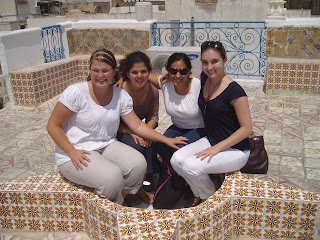
After a picnic in the park overlooking governmental buildings to one side and the souks to the other, we headed back to al Marsa exhausted and dehydrated. I did, however, discover that there is a bus to and From downtown Tunis that stops less than a block from my house. Score! After a much needed shower, I then spent the afternoon at a friend's house, eating fresh almonds and Mars bars that his host mom gave us--we thought it was random, too. That night, we went down to the al Marsa beach and hung out under the stars, amongst the craziness that is al Marsa on a Saturday night. After 1 in the morning, there were still whole families complete with young children out and about. But it was nice to know that we're living in such a bustling place full of life--who needs Tunis when you have al Marsa?!
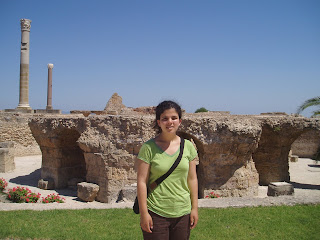
Today, after my sorry attempt at doing homework in the morning, I went to Carthage. It is a place I didn't know a lot about before visiting (or after visiting due to a lack of signage anywhere--I think I was in Carthage, anyway), but I did know that it was a must-see. I wondered the city for about four hours with a friend. The ruins are scattered around the city and you pay for a pass to access them all. Of course, it is impossible to see it all in one day, but we managed to visit four sites--the museum, the Roman baths, the theatre, and the old villas. Seeing only the crumbling dust-colored ruins of the town, it was hard to imagine a whole different world existed on the same soil. I was lucky enough to be with an archeologist (this program really brings such a sprinkling of people together) who had really interesting things to say about the tombs we were able to see and the artifacts they had excavated. We also accidently walked past the president's palace and had some scary experiences with the guards there, their guns flopping in every direction.
And now, I'm back at home with my family, already nostalgic about the great weekend and looking forward to more adventures (...I think I'm going to my first Tunisian wedding tomorrow!).

Thursday, July 2, 2009
How many camels are you?
Well, the last of the blog posts by my friends about our trip this past weekend have been posted, so it's about time I finish before all of the details become completely blurry...
After a night of lounging by the pool (arguably the first real break I've taken since I got here), I woke up early to go on a tour of the medina of Tozeur. Tozeur is a beautiful city, made up of sand colored walls that criss-cross the city  like the maze. There are shops jutting off and sitting under archways, as well as a large central market. Here, I tried date juice for the first time, a super sweet drink sold by old men sitting on street corners. They just have little buckets of water to rinsse the cups out after you've drinken and it's all very communal. After the tour of the medina, I went shopping (again) with the some friends. We went to a berbere shop where I bought traditional pants--they're very cool and I'll show you all back in the US. The shop keeper was this hilarious young guy who was quite smitten with one of the girls. At one point, he asked her, "how many camels are you?" and then went on to say he would pay 30,000 camels and 5 ferraris to marry her. I'm not sure if that many camels even exist in Tunisia, but we got the message. I'm also starting to perfect/better my haggling skillz. The shop keeper said I was just like his people--strong and stubborn, i.e. I got the price I wanted!
 like the maze. There are shops jutting off and sitting under archways, as well as a large central market. Here, I tried date juice for the first time, a super sweet drink sold by old men sitting on street corners. They just have little buckets of water to rinsse the cups out after you've drinken and it's all very communal. After the tour of the medina, I went shopping (again) with the some friends. We went to a berbere shop where I bought traditional pants--they're very cool and I'll show you all back in the US. The shop keeper was this hilarious young guy who was quite smitten with one of the girls. At one point, he asked her, "how many camels are you?" and then went on to say he would pay 30,000 camels and 5 ferraris to marry her. I'm not sure if that many camels even exist in Tunisia, but we got the message. I'm also starting to perfect/better my haggling skillz. The shop keeper said I was just like his people--strong and stubborn, i.e. I got the price I wanted!

After the free time, we continued onward, going to the Dar Cherait, a museum where we learned about the traditional clothing and customs of the South. It was a pretty typical museum, filled with scary manequins, but it also displayed some interesting ocassions--like traditional weddings, hamam visits, etc. We then went to the oasis of Tozeur, where we rode horse-drawn carriages into the center. This was a pretty scary experience--sitting backwards in a rickety cart with no seat belts and barely anything to hold on to, while taken narrow curves...But once we reached the center, we took a tour, looking at pomegranite, banana and date
trees. We also got to sample the fresh dates and see one of the workers climb to th e very top of the tree barefoot and without protection to collect the fruit. Impressive. He made it look so easy that some of the Americans tried. Needless to say, their attempts did not turn out as smoothly.
trees. We also got to sample the fresh dates and see one of the workers climb to th
 e very top of the tree barefoot and without protection to collect the fruit. Impressive. He made it look so easy that some of the Americans tried. Needless to say, their attempts did not turn out as smoothly.
Afterwards, we visited a zoo in Tozeur. It was a mixture of one of the saddest places I've been to before and one of the funniest. Our tour guide was a bit of a comedian. He started the tour by showing us a wall of bones and pointing out which ones came from which tourists--on one side, the American tourists, then the Germans, the French, even Tunisian. He then preceeded to call us "tourists!!" every time he wanted to get our attention during the tour. At the end, he did a show with snakes, lizards, and a scorpian named Janet Jackson, whose cage was a cigarette box called a "garage."
After lunch at the hotel, it was time to head to the place we had all been looking forward to--the Sahara Desert! During the two or so hour ride, we made a few stops. First, we visited one of the locations where Star Wars was filmed! I know it was a scene from the first movie, but I can't exaclty pin which one--something about miles and miles of sand in every direction kind of looks the same. In actuality though, the area is a shrine that sits on top of a huge hill. Getting out was our first experience in the desert and it definitely has a different feel to it--hot, heavy, but unbelievably unbelievable. 

We then continued on to the Chott Djerid, a salt marsh that has been split in  two by the recent construction of a road, which follows the streams of red, green and purple salt for miles and miles. We got out at a little tourist attraction made on the side of the road. They built a castle and other structures out of the salt, like a cross between sand castles and winter ice sculptures that reminded me of the Winter Carnival in St. Paul. We then visited another tourist hot spot, premature sand stone formations collection like boulders. I didn't really understand the geology behind, although some of the more scientifically minded students tried explaining. The boulders were mostly just fun to climb on and jump off of.
 two by the recent construction of a road, which follows the streams of red, green and purple salt for miles and miles. We got out at a little tourist attraction made on the side of the road. They built a castle and other structures out of the salt, like a cross between sand castles and winter ice sculptures that reminded me of the Winter Carnival in St. Paul. We then visited another tourist hot spot, premature sand stone formations collection like boulders. I didn't really understand the geology behind, although some of the more scientifically minded students tried explaining. The boulders were mostly just fun to climb on and jump off of.
Finally, we reached the Sahara Desert that we were expecting--sand dune after sand dune. We took a camel trek for about a half hour to our campsite. The camel ride was bumpy, a l ittly painful at first, but very fun. The next day, my legs were throbing, but it was definitely worth it. Our campsite was perhaps too posh to really call camping--we had huge air conditioned tents and comfortably housed 6 in large beds, a bar/ cafe, a tent for lounging, a restuarant and a music tent. There were also showers that I tried to brave the next day, but it was really more of a drizzle that only removed on of the many layers of fine sand covering me. That evening, we were treated to a huge 5 course meal lit by lanterns. We then watched and listened to traditional belly dancing and drumming. Somehow, I was pulled up to the makeshift stage and danced with the belly dancer and two other girls from the group. We were up there for what felt like forever, barely able to keep up with the intricate movements and laughing too much to really try. After a game of mafia, I took off towards the sand dunes and spent hours star gazing. We saw countless shooting stars and could easily recognize constellation after constellation. It was amazing to see the sky so clearly and while laying on beds of sand, nonetheless. One of my friends made an interesting comment about wondering who all had walked on the sand we let fall through our fingers. It's amazing to think about and to have been sitting on one little piece of a region so large and encompassing.
 ittly painful at first, but very fun. The next day, my legs were throbing, but it was definitely worth it. Our campsite was perhaps too posh to really call camping--we had huge air conditioned tents and comfortably housed 6 in large beds, a bar/ cafe, a tent for lounging, a restuarant and a music tent. There were also showers that I tried to brave the next day, but it was really more of a drizzle that only removed on of the many layers of fine sand covering me. That evening, we were treated to a huge 5 course meal lit by lanterns. We then watched and listened to traditional belly dancing and drumming. Somehow, I was pulled up to the makeshift stage and danced with the belly dancer and two other girls from the group. We were up there for what felt like forever, barely able to keep up with the intricate movements and laughing too much to really try. After a game of mafia, I took off towards the sand dunes and spent hours star gazing. We saw countless shooting stars and could easily recognize constellation after constellation. It was amazing to see the sky so clearly and while laying on beds of sand, nonetheless. One of my friends made an interesting comment about wondering who all had walked on the sand we let fall through our fingers. It's amazing to think about and to have been sitting on one little piece of a region so large and encompassing.
The next morning, we took little carts back to the bus. That is, little horse-drawn carts that had no closure to them--people were falling off at every turn. The day was spent traveling to Djerba, which would be our final stop. Today was mainly devoted to the architecture of the region, with many stops to look at different houses. In the South, it used to be very common for people ot live underground in houses that had courtyards that were deep pits and had rooms coming off under the ground. We stopped at another location where Star Wars was filmed, this scene, however, was a little more familiar. We also had lunch in one of the houses, sitting on mats on the floor and sharing bowls of couscous at a long table of 15. At lunch, two of the people from the group, dressed as a couple in a traditional wedding ceremony.
 the group, dressed as a couple in a traditional wedding ceremony.

We stopped at all sorts of beautiful panarama's overlooking abandoned towns and thriving villages, including the town of Matmata. The city has constructed white "MATMATA" letters in the style of Hollywood and we all gathered around to get our picture taken with them. Our final stop for the day was a granery that has since been abandoned. Like most historical sites in Tunisia, you are allowed to climb all over it and we had a lot of fun taking group photos and eating ice cream in the old storage spaces.
That evening, we crossed the bridge into Djerba, an island off the coast of Tunisia. It is considered one of the must-go-to places of the country and, because of that, very touristy. We stayed at what was probably the nicest hotel I've ever been to. We had huge rooms overlooking a colorful garden, three swimming pools (salt water, fresh water and one with a slide!), were only a short walk from the beach and the buffet was incredible! I spent the evening swimming in the pool, swimming in the sea, stuffing myself silly and then dancing with the other guests to dances led by the staff. If I can imagine what a cruise is like, this is it minus the boat.
The next morning I went shopping in the medina with some friends and then started feeling guilty for having not started my homework, so we spent the rest of the morning at the hotel cramming. We left the hotel after lunch and spent the afternoon making little stops around the island. We visited the Ghriba Synagogue, which has the oldest torah in the world and is well-known throughout the Maghreb. Being there was surreal. As we were leaving we passed people coming in to pray while the call to prayer was sung in the background. Nonetheless, it was a really good example of people living together peacefully and acknowledging similarities despite such varying beliefs.
That afternoon we also visted a beautiful pottery town and a medina. Like all medinas, this town was bustling and full of vendors hassling us. But before we had free time to shop, we stopped at a church that we were supposed to visit. For some reason or another, however, we were not allowed to enter, which was a contradictory ending to the hospitality we'd experienced at the other religious sites. Our final group stop was a hostel in the area that had played an historical role for trade in the region. We then headed to the airport, where we flew back to Tunis and took a bus home to our host families. I must say though, my second pang of culture shock came at the airport, where the security was reminiscent of the 1990's in the U.S. It was unexpected, but very appreciated, because the last thing any of us wanted was to be held back given how exhausted we were.
And now, I am back in al Marsa. I have a test tomorrow that I should be studying for and am looking forward to a nice relaxing weekend filled with both recovery and nostalgia.
Subscribe to:
Posts (Atom)


